
Modified Bitumen Roofing Contractor in Colorado
Modified Bitumen repair, replacement, restoration, and inspections for commercial properties across Colorado.
You're in the Right Place
If you manage or own a commercial property in Colorado with a modified bitumen roof — or you’re evaluating it as an option for an upcoming reroof or replacement — Statewide Roofing has the field experience to give you a straight, honest assessment.
We’ve installed, repaired, and replaced modified bitumen roofing systems on commercial buildings across the Front Range. We know how these roofs perform over time, where they tend to develop problems, and how to evaluate whether a roof still has serviceable life or has reached the point where replacement is the smarter investment.
If your modified bitumen roof is leaking, aging, or coming up for review — we’ll tell you exactly what we find and what we recommend.
What Is Modified Bitumen Roofing?
Modified bitumen is an asphalt-based roofing membrane engineered specifically for low-slope and flat commercial roofs. The base material is asphalt, but unlike traditional built-up roofing, modified bitumen incorporates polymer modifiers that significantly improve flexibility, elongation, and resistance to thermal stress and weathering.
There are two primary modifier types used in commercial modified bitumen systems:
APP (Atactic Polypropylene)
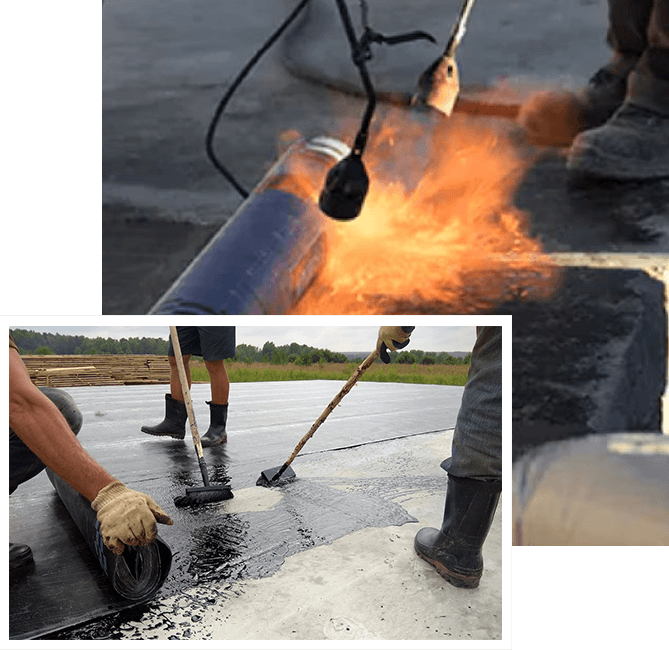
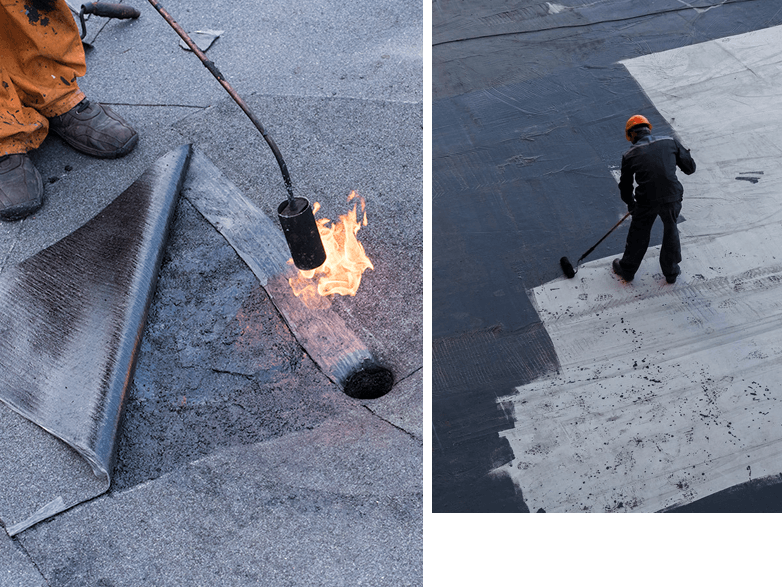
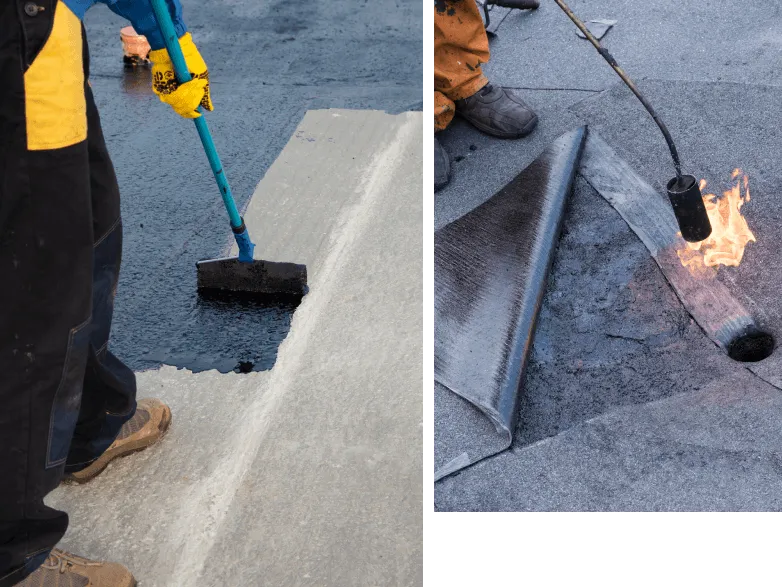
APP (Atactic Polypropylene) — a plastomeric modifier that produces a stiffer membrane with excellent UV resistance and high heat tolerance. APP-modified membranes are typically installed by torch application, which heat-fuses the material to the substrate or underlying ply. They perform well in hot climates and on roofs with high solar exposure.
SBS (Styrene-Butadiene-Styrene)
SBS (Styrene-Butadiene-Styrene) — a elastomeric modifier that produces a more rubber-like membrane with greater flexibility at low temperatures. SBS systems are well-suited to climates with significant temperature swings, making them a common choice on Colorado commercial roofs. They can be installed by torch, cold adhesive, or heat welding depending on the specific product and assembly.
Both modifier types are available with fiberglass or polyester reinforcement, or a combination of both. Polyester-reinforced membranes offer greater tensile strength and puncture resistance. Fiberglass-reinforced systems provide superior dimensional stability. Many high-performance assemblies use a base sheet of one reinforcement type with a cap sheet of another.
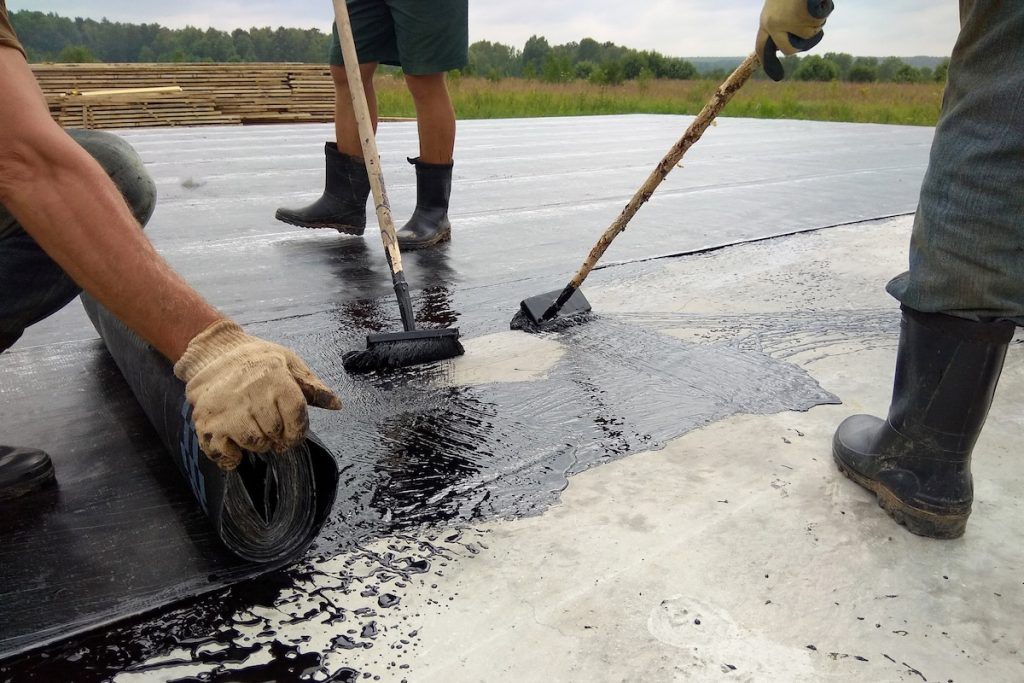
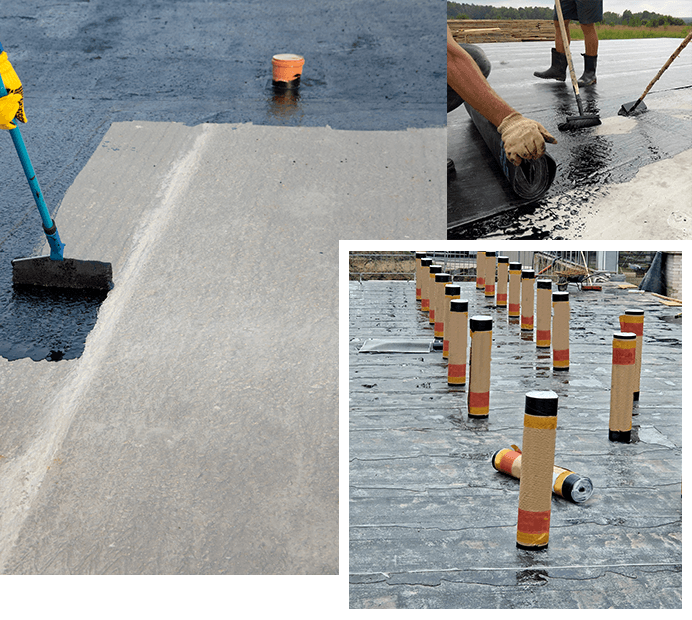
Modified bitumen systems are typically installed in two or more plies — a base sheet bonded to the substrate and a cap sheet applied over it. The cap sheet surface is usually granule-surfaced for UV protection and foot traffic resistance, smooth-surfaced for use under a coating, or foil-faced for reflectivity.
Why Modified Bitumen Has Stayed Relevant in Commercial Roofing
Modified bitumen became a dominant commercial roofing system because it offered a meaningful upgrade over traditional built-up roofing while remaining compatible with the material knowledge and installation practices that the industry already understood. It brought polymer-enhanced performance — better flexibility, better cold-weather behavior, better resistance to thermal cycling — in a format that could be installed by experienced crews without entirely new equipment or methods.
Decades of field performance have confirmed that well-installed modified bitumen roofs are genuinely durable. The multi-ply assembly provides redundancy that single-ply systems don’t offer — if the cap sheet is damaged, the base sheet continues to function as a waterproofing layer. That redundancy matters on roofs with rooftop equipment, significant service traffic, or complex detail conditions.
Modified bitumen is also a repairable system. Localized failures at seams, flashings, and penetrations can typically be addressed with compatible materials and proven repair methods, without requiring removal of the surrounding membrane.
What Determines Modified Bitumen Performance Over Time
The membrane type and modifier chemistry are starting points. Long-term performance depends heavily on the quality of the installation and the condition of every component in the assembly.
Seam integrity
Seam integrity is the most critical factor. Torch-applied seams that are properly executed create fully fused, monolithic joints. Seams that are underheated, contaminated, or rushed during application are the most common source of modified bitumen failures. Cold-applied seams depend on adhesive coverage and cure conditions. Either way, seam condition tells the story of how the roof will hold up over time.
Flashing details
Flashing details at walls, curbs, drains, and penetrations are where most leaks begin. Modified bitumen flashing work requires careful prep, correct material selection, and attention to termination details. Flashing that is improperly embedded, not fully adhered, or applied over an unprepared surface will fail — often well before the field membrane shows any sign of wear.
Drainage performance
Drainage performance is a significant variable on low-slope roofs. Modified bitumen tolerates some ponding better than certain single-ply membranes, but chronic standing water accelerates surface wear, stresses seams, and creates ongoing leak risk at drains and perimeter edges.
Substrate and insulation condition
Substrate and insulation condition determine whether the overall assembly is still worth repairing or maintaining. Wet or deteriorated insulation below the membrane changes how the system responds to load and thermal movement — and signals that more than a surface repair may be needed.
Rooftop traffic and service activity
Rooftop traffic and service activity are among the most avoidable sources of damage. Unprotected membrane in service pathways, around HVAC equipment, and near rooftop access points is subject to puncture and abrasion. Walk pads and defined service routes make a meaningful difference on roofs that see regular maintenance activity.
What We Evaluate on Every Modified Bitumen Roof
- Seam condition and adhesion across the full membrane area
- Flashing integrity at all curbs, walls, penetrations, and perimeter edges
- Drain condition, ponding water locations, and drainage adequacy
- Surface wear, blistering, granule loss, and membrane oxidation
- Punctures, splits, or damage from rooftop service traffic
- Confirmed and suspected leak locations and origin points
- Insulation and substrate condition, including moisture scanning where warranted
Modified Bitumen Repair vs. Restoration vs. Replacement
Repair
Repair is appropriate when failures are localized — a seam section that has opened, a flashing that has separated, a puncture in the field membrane, or a drain detail that is no longer watertight. When the surrounding assembly is sound and there is no significant moisture below the membrane, targeted repairs using compatible materials and correct prep can extend service life substantially. Modified bitumen is one of the more forgiving commercial systems when it comes to repairability — the material accepts compatible patches and flashing repairs reliably when the work is done correctly.
Restoration
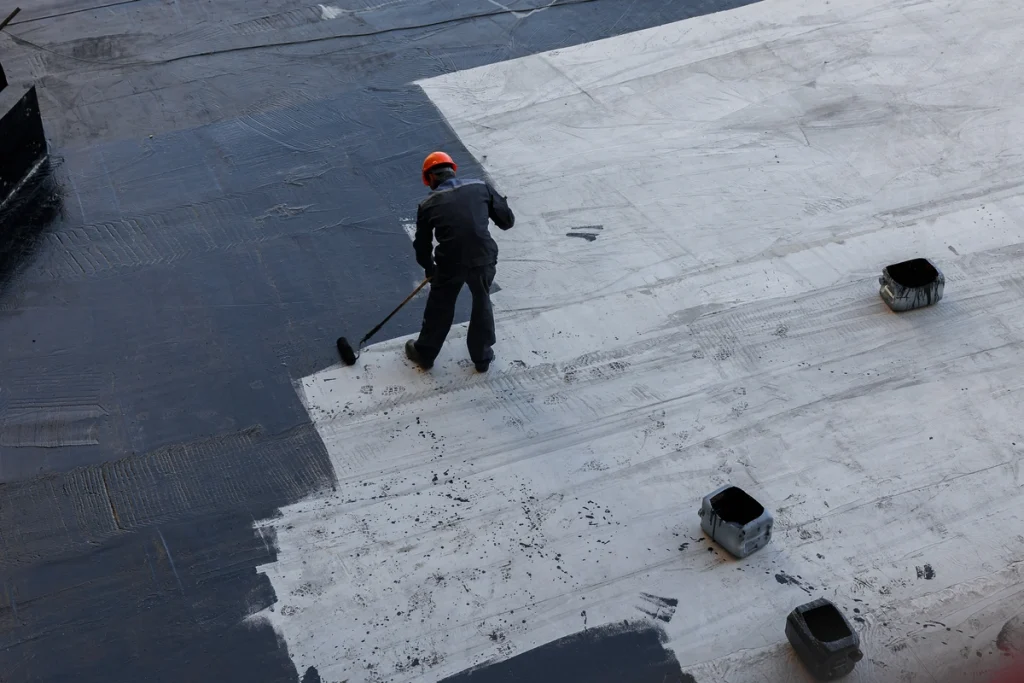
Restoration using a fluid-applied coating may be a viable option for modified bitumen roofs where the membrane surface is oxidized or granule-depleted but the underlying assembly is still dry and structurally intact. Coating a modified bitumen roof can restore reflectivity, protect an aging surface, and extend service life without a full tear-off. Substrate condition and coating product compatibility must be confirmed before proceeding — not every aging modified bitumen roof is a good restoration candidate.
Replacement
Replacement becomes the appropriate choice when seam failures are widespread, moisture has infiltrated the insulation, flashing conditions are systemic rather than isolated, or the membrane has deteriorated past the point where surface repairs are reliable. At that stage, continued patching typically costs more over time than a planned replacement — and carries ongoing risk of interior damage and escalating repair cycles.
Where Modified Bitumen Is Commonly Specified
- Office buildings and professional parks
- Retail centers and strip centers
- Warehouses and distribution facilities
- Multifamily residential properties with flat or low-slope roof sections
- Schools, universities, and institutional buildings
- Churches and assembly facilities
- Industrial and manufacturing buildings
A Note on Existing Warranties
If your modified bitumen roof is still within an active manufacturer’s warranty period, that document deserves a careful review before any repair or maintenance work is authorized — and before any contractor gets on the roof.
Modified bitumen manufacturer warranties — including system-level and NDL warranties from major manufacturers — typically require that all repair and maintenance work be performed by a contractor certified or approved by that manufacturer, using compatible, approved materials and methods. This applies not just to membrane repairs, but to any work that touches the roofing system: flashing corrections, penetration additions, rooftop equipment modifications, and drainage work. Problems caused by unauthorized modifications, including work performed by non-certified contractors or third-party vendors servicing rooftop equipment, are generally excluded from warranty coverage Sentry Roof Services — and in some cases can void coverage beyond just the area where the work was done.
Some warranties also require the owner to notify the manufacturer before repair work begins, and to maintain documented records of all inspections and work performed. Failing to meet those requirements — even on otherwise routine maintenance — can affect the validity of a claim later.
We review warranty status as part of our evaluation process on any existing modified bitumen roof. If your roof is under an active warranty, we’ll help you understand what it requires, whether the repair scope is compatible with maintaining coverage, and how to proceed correctly. If the warranty has expired, we can discuss whether the existing system qualifies for any manufacturer renewal or extension program before recommending a full replacement.
Frequently Asked Questions
Modified bitumen is an asphalt-based commercial roofing membrane reinforced with fiberglass or polyester and enhanced with polymer modifiers — either APP or SBS — that improve flexibility, weather resistance, and thermal performance. It is installed in multiple plies on low-slope and flat commercial roofs and has been a standard commercial roofing system for decades.
APP (Atactic Polypropylene) produces a stiffer, plastomeric membrane with strong UV and heat resistance, typically installed by torch application. SBS (Styrene-Butadiene-Styrene) produces a more flexible, rubber-like membrane that performs well in cold temperatures and under thermal cycling — making it a strong fit for Colorado’s climate. The right choice depends on the building, the climate, and the installation method.
Yes, particularly SBS-modified systems, which are engineered for flexibility in cold temperatures and thermal cycling — conditions that are common on the Front Range. The multi-ply assembly also provides redundancy that single-ply systems don’t offer, which matters on roofs with rooftop equipment, foot traffic, or complex detail conditions.
Often, yes. Modified bitumen is one of the more repairable commercial roofing systems. When failures are isolated — a seam, a flashing detail, a puncture — and the rest of the assembly is still sound with no significant moisture below the membrane, targeted repairs using compatible materials can extend service life meaningfully. The evaluation has to determine whether problems are localized or part of a broader pattern of deterioration. That distinction drives the repair-versus-replace decision.
A properly installed and maintained modified bitumen roof typically performs for 20 to 30 years, depending on membrane thickness, ply count, installation quality, climate exposure, and maintenance history. Multi-ply assemblies with heavier cap sheets and good drainage conditions generally outperform thinner, single-ply-equivalent configurations. Age alone is not a reliable indicator of condition — a field evaluation is always the more useful measure.
They can, if the work isn’t handled correctly. Most modified bitumen manufacturer warranties — particularly system-level and NDL warranties — require that repairs be performed by a contractor who is certified or approved by the manufacturer, using compatible, approved materials. Work done by non-certified contractors, or using incompatible products, can void coverage in the repaired area or across the full roof system. Some warranties also require manufacturer notification before repair work is authorized, and documentation of all work performed. If your roof is within an active warranty period, we review those requirements before recommending any scope of work — so the repair addresses the problem without putting your coverage at risk.